What day is July 1, 2026?
July 1, 2026 is a Wednesday. That weekday matters for work rosters, appointment calendars, campsite reservations, payroll reminders, school notes, and family travel planning.
Canada stat holiday
Canada Day 2026 falls on Wednesday, July 1. Use this page to confirm the date, weekday, stat holiday status, and calendar action for the Canada Day 2026 holiday.
The main planning detail is the weekday. Because July 1, 2026 is a Wednesday, Canada Day does not automatically create a long weekend for a typical Monday-Friday schedule.

Canada Day 2026 is Wednesday, July 1, 2026. If you are checking a work calendar, payroll reminder, school note, family planner, travel booking, or shared calendar, mark July 1 first and then confirm any local schedule rules that apply.
Canada Day is tied to July 1 each year, so the date does not move to match a Monday or Friday. What changes each year is the weekday. In 2026, the weekday is Wednesday.
| Holiday | Canada Day |
|---|---|
| 2026 date | Wednesday, July 1, 2026 |
| Date rule | July 1 every year |
| Holiday status | Stat holiday / statutory holiday in Canada |
| Typical planning note | Check province, territory, workplace, or federal rules |
View the Canada public holidays 2026 calendar imagesif you need the full-year and monthly Canada calendar views.
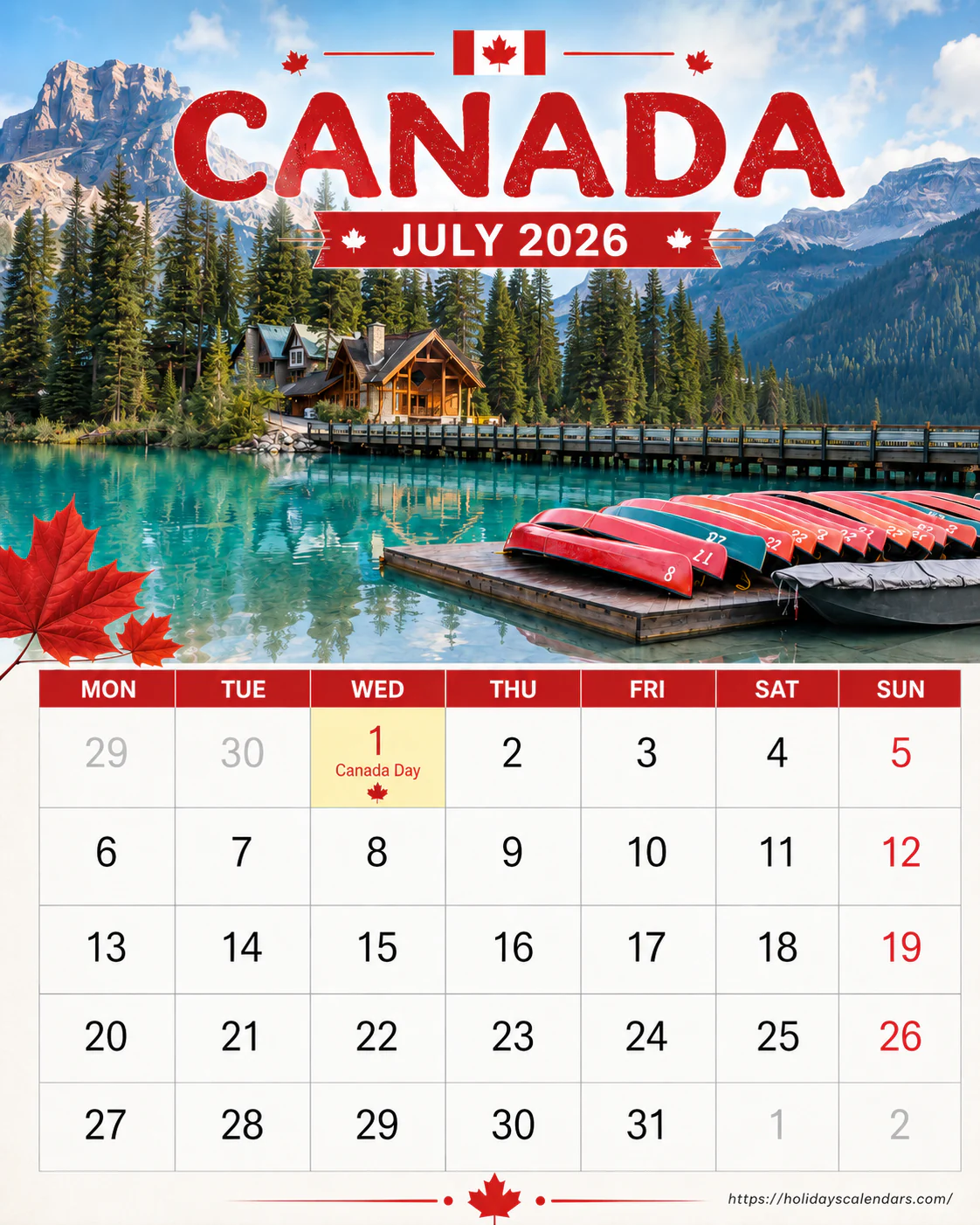
Many Canada Day searches are really calendar-checking searches: what date is Canada Day, what day is July 1, and whether 1 July 2026 is the same holiday date. The answer is direct: use Wednesday, July 1, 2026 for Canada Day.
If you are updating a shared work calendar, family planner, travel itinerary, payroll note, school reminder, or booking checklist, keep the Canada Day entry separate from any local closure note. That keeps the national date clear while leaving room for province, territory, employer, school, transit, or store-specific rules.
July 1, 2026 is a Wednesday. That weekday matters for work rosters, appointment calendars, campsite reservations, payroll reminders, school notes, and family travel planning.
Canadian readers may see the date written as July 1, 2026 or 1 July 2026. Both point to the same Canada Day date on the 2026 calendar.
For shared planning, label the entry Canada Day 2026 and use Wednesday, July 1. Then add a separate note for workplace hours, school closures, or local service changes.
Yes. Canada Day is commonly described as a Canada stat holiday and as a statutory holiday. For most readers, the practical question is not only the name of the holiday, but which employment, school, bank, or service rule applies to their situation.
The safest way to use this page is to start with the July 1 date, then check the rule that matches your workplace, province or territory, federal-regulated status, school board, bank, or local service.
This distinction matters because readers often ask the same question in different ways: is Canada Day a stat holiday, is it a statutory holiday, is July 1 a public holiday, or do we get Canada Day off? Those questions point to the same starting date, but not always to the same employment answer.
Many Canadians ask whether Canada Day is a stat holiday. For 2026 planning, July 1 is the date to check first, then confirm the workplace or province rule that applies to you.
Canada Day is treated as a statutory holiday in Canadian holiday references, with employment and pay details depending on federal, provincial, territorial, or employer rules.
For federally regulated employees, Canada Labour Code general-holiday rules are the key reference. This does not replace provincial or employer-specific guidance.
Provincial and territorial employment standards can shape pay treatment, substitute days, premium pay, and who is covered. Use the July 1 date first, then confirm the local rule.
A school board, university, clinic, warehouse, call centre, store, or municipal office may publish its own Canada Day hours. Check the local notice before assuming a closure.
Canada Day is a public holiday in common reader language, but employment coverage can depend on the jurisdiction. Federal wording is most useful for federally regulated work.
Canada Day 2026 is a midweek holiday. That makes the planning answer different from a Monday holiday: there is no automatic three-day weekend for a typical Monday-Friday workweek.
The most useful long-weekend question is therefore not only whether Canada Day is a holiday, but how the surrounding workweek behaves. In 2026, the holiday interrupts the middle of the week, so any extended break depends on leave approval, school schedules, staffing coverage, or local travel plans.
Canada Day 2026 falls on Wednesday. For a typical Monday-Friday schedule, that means the holiday itself does not automatically create a three-day weekend.
If your workplace allows it, taking Thursday, July 2 and Friday, July 3 can create a five-day break from Wednesday through Sunday.
If you are checking whether you get Canada Day off, confirm your province, territory, employer policy, union agreement, or federal-regulated status.
Because the holiday lands on Wednesday, Monday, June 29 and Tuesday, June 30 are normally separate workdays unless your employer, school, or travel plan says otherwise.
If you want a longer summer break, request July 2 and July 3 early enough for staffing, payroll, project coverage, child care, and travel bookings to be adjusted.
A five-day break would run from Wednesday through Sunday, with Monday, July 6 as the usual return day for many schedules. Confirm shift calendars before booking.
Planning note: use Wednesday, July 1 as the holiday date. If you want a longer break, check whether Thursday, July 2 and Friday, July 3 are available as vacation days, personal days, or regular workdays.
Download a single-date ICS file for Wednesday, July 1, 2026. The file is designed for Google Calendar, Apple Calendar, Outlook, and other apps that support ICS files.
File note: this download includes Canada Day 2026 only. For the full annual list, use the Canada public holidays 2026 calendar.
Canada Day is on July 1 because the date marks Confederation in 1867. The holiday is used for national calendar planning, civic observances, family time, and community celebrations across Canada.
For a holiday calendar, the important point is simple: Canada Day is fixed to July 1. If July 1 falls midweek, as it does in 2026, the holiday stays on that date while local schedules and workplace rules determine how the day is handled.
The holiday was historically known as Dominion Day before the Canada Day name became the familiar public name. For readers checking a 2026 calendar, that history explains why July 1 is treated as the national celebration date even when the practical day-off details still depend on local rules.
Canada Day celebrations, ceremonies, fireworks, concerts, and community gatherings can be part of the wider day, but this page keeps the focus on the date, weekday, holiday status, calendar entry, and planning decisions that apply before you look up a local event schedule.
Use this section as a planning checklist. Canada Day can affect public offices, banks, post offices, schools, retail hours, transit, clinics, recreation facilities, and customer support desks, but exact schedules are local or institution-specific.
For a Wednesday holiday, check time-sensitive services before the week begins. Payment deadlines, parcel pickup, prescription refills, medical appointments, recreation bookings, commuter routes, and city-service counters may all have different Canada Day instructions.
Federal and many public offices commonly use Canada Day as a holiday, but local service counters and appointment systems should still be checked.
Bank branches, payment processing, payroll timing, and transfers can follow holiday schedules. Online banking may remain available while settlement timing shifts.
Post office hours and mail delivery can be affected by public holiday schedules. Confirm local branch hours before visiting on or near July 1.
Retail hours, transit, recreation facilities, medical offices, clinics, and customer support desks may use special local hours.
Grocery stores, pharmacies, convenience stores, fuel stations, restaurants, and attractions can follow reduced, extended, or location-specific holiday hours.
Transit agencies, parking offices, road closures, ferry schedules, and downtown event routes may use holiday timetables. Check the city or operator notice before travelling.
Local fireworks, public celebrations, and event schedules vary by city or municipality. Check local city or event sources closer to July 1 if you need times, locations, transit changes, or viewing details.
Canada Day stays on July 1 each year. The table below shows the weekday around 2026, which is useful when checking whether the holiday creates a weekend, midweek break, or regular workweek interruption.
| Year | Canada Day date |
|---|---|
| 2025 | Tuesday, July 1, 2025 |
| 2026 | Wednesday, July 1, 2026 |
| 2027 | Thursday, July 1, 2027 |
| 2028 | Saturday, July 1, 2028 |
| 2029 | Sunday, July 1, 2029 |
| 2030 | Monday, July 1, 2030 |
Canada Day 2026 is on Wednesday, July 1, 2026.
Canada Day 2026 falls on Wednesday. If you are marking a work calendar, school note, or family planner, use Wednesday, July 1.
Yes. Canada Day is commonly treated as a Canada stat holiday or statutory holiday. Exact pay, lieu day, and coverage details can depend on federal, provincial, territorial, or employer rules.
Not automatically. Canada Day 2026 falls on Wednesday, so a typical Monday-Friday schedule does not get a built-in three-day weekend.
Many workers have July 1 as a holiday, but your exact day-off and pay treatment depends on the rules that apply to your job and location.
Canada Day is on July 1 because that date marks Confederation in 1867, when the Dominion of Canada was formed.
Yes. This page provides a single-date ICS file for Wednesday, July 1, 2026.
Confirms Canada Day on the official Canada public holiday reference.
Supports general-holiday wording for federally regulated employees.
Supports banking and payment-schedule checks around Canadian holidays.
Supports checking post office hours before visiting a branch.
Supports the July 1 Confederation context for Canada Day.