U.S. federal holiday guide
Are There 11 or 12 Federal Holidays?
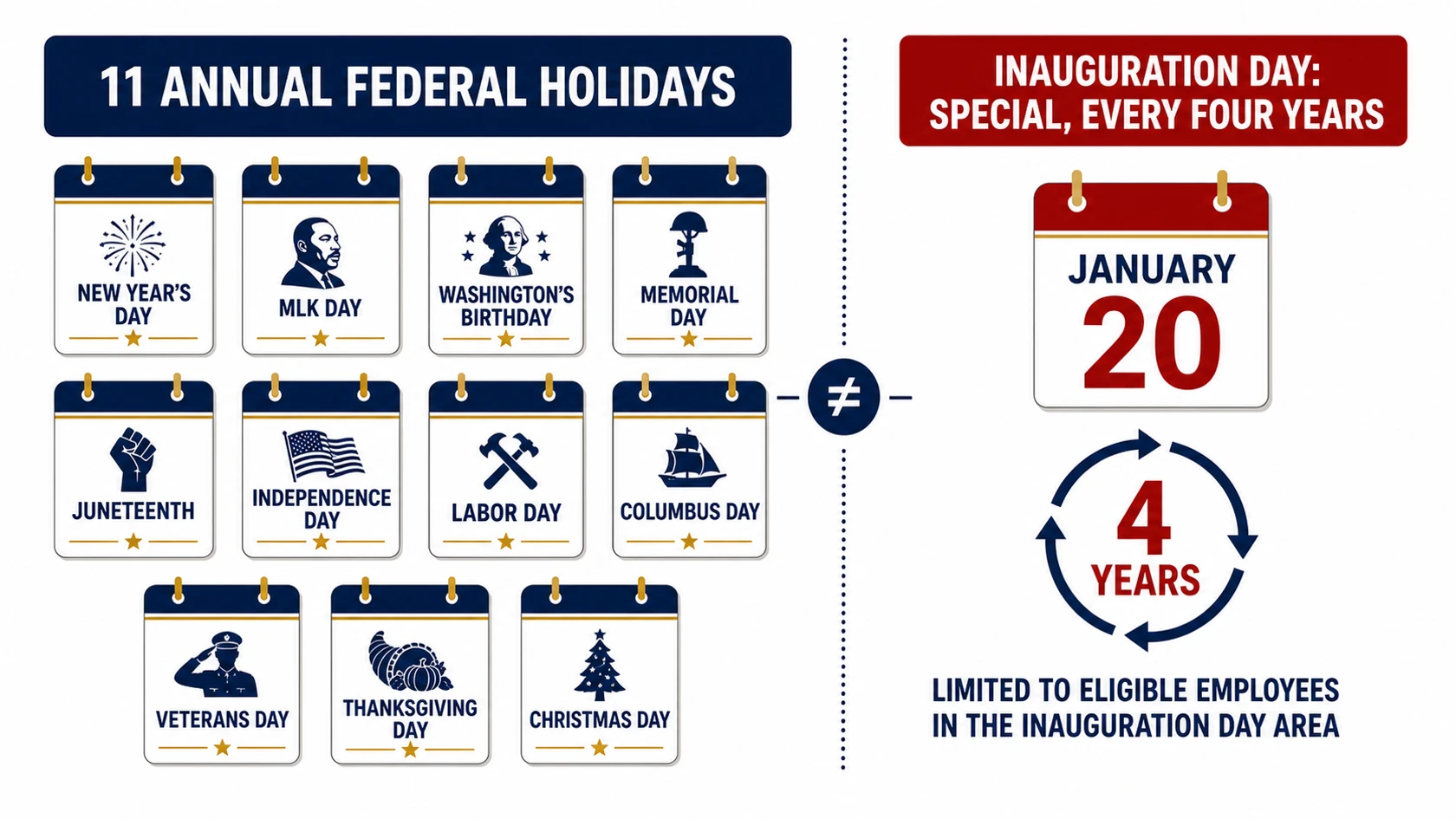
The United States has 11 federal holidays that recur every year. Some lists say 12 because they also count Inauguration Day, a special federal holiday that occurs once every four years and applies only to eligible employees working in the legally defined Inauguration Day area.
- Annual federal holidays
- 11
- Possible 12th count
- Inauguration Day
- Newest annual holiday
- Juneteenth, added in 2021
Annual calendar
The 11 Annual U.S. Federal Holidays
The annual count comes from the legal public holidays listed in 5 U.S.C. 6103(a). These dates recur every year, although the weekday observed by federal employees can move when a fixed-date holiday falls on a Saturday or Sunday. The holiday name below follows federal wording; state calendars and common usage may use a different name for the same date.
- New Year's DayJanuary 1
- Birthday of Martin Luther King, Jr.Third Monday in January
- Washington's BirthdayThird Monday in February; commonly called Presidents' Day
- Memorial DayLast Monday in May
- Independence DayJuly 4
- Labor DayFirst Monday in September
- Columbus DaySecond Monday in October; state and local naming can differ
- Veterans DayNovember 11
- Thanksgiving DayFourth Thursday in November
- Christmas DayDecember 25
This is the count used for a normal nationwide federal holiday calendar. It does not mean every private business, school, state office, bank branch, or local service must close on all 11 dates.
The alternative count
Why Do Some Sources List 12 Federal Holidays?
A list can reach 12 when it combines the 11 annual legal public holidays with Inauguration Day. That total is useful only when the list clearly explains that the extra date is not annual and is not a nationwide day off for all federal employees.
Is Inauguration Day a Federal Holiday?
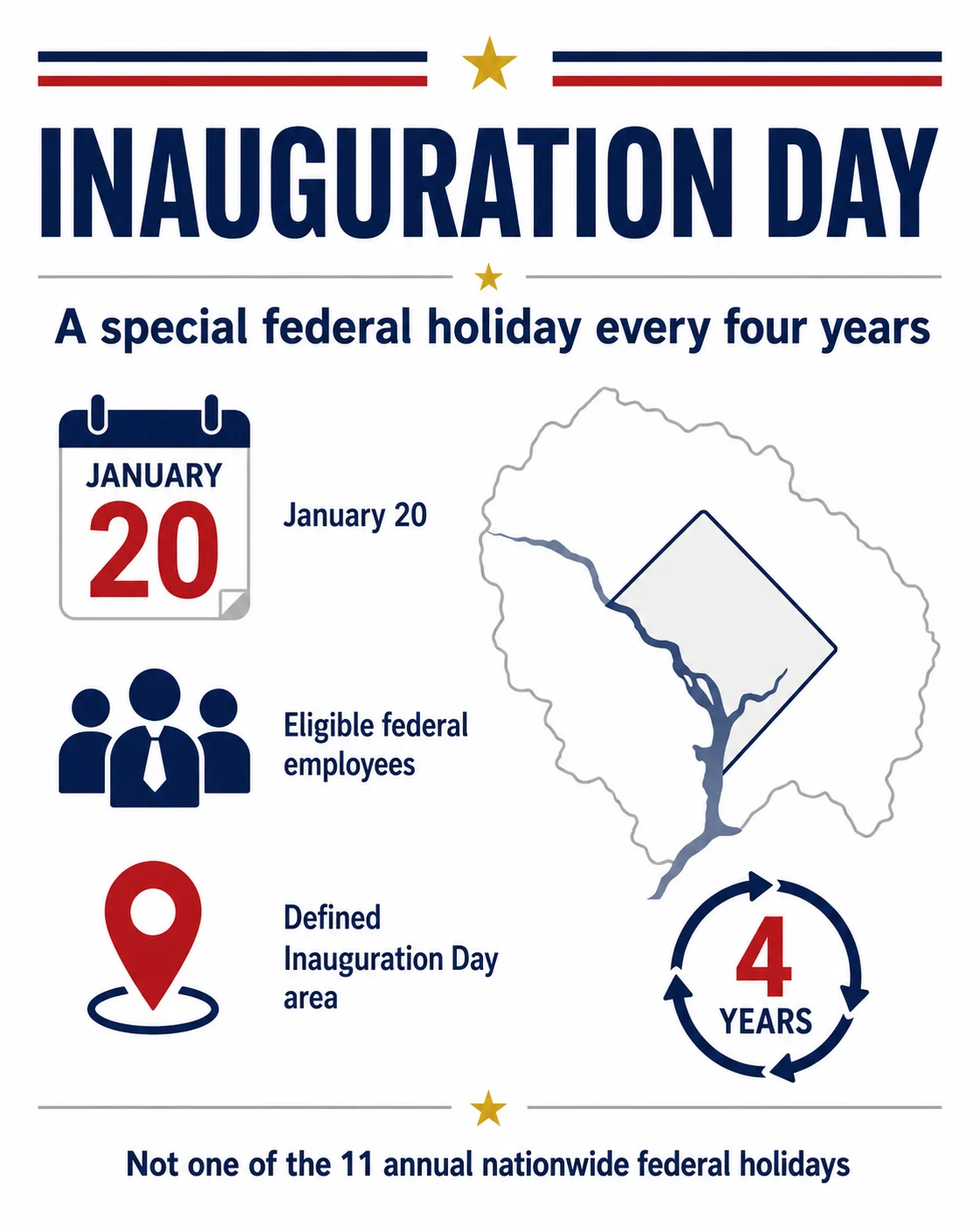
Yes, but it has a narrower legal role. Under 5 U.S.C. 6103(c), January 20 is treated as a holiday for pay and leave purposes every fourth year after 1965 for eligible federal employees in the Inauguration Day area. It should not be inserted into the recurring annual list as if it applied nationwide every year.
Who Gets the Inauguration Day Holiday?
Eligibility depends on both the employee's federal status and work location. The statutory area covers the District of Columbia and specified nearby jurisdictions in Maryland and Virginia. An employee elsewhere in the country does not receive an additional nationwide federal holiday merely because a presidential inauguration occurs.
Practical rule: use 11 for the annual U.S. federal holiday count. Mention 12 only when Inauguration Day and its limited scope are explicitly included.
The newest annual holiday
How Juneteenth Changed the Federal Holiday Count
Juneteenth National Independence Day became a legal public holiday when the Juneteenth National Independence Day Act was signed on June 17, 2021. Its addition increased the recurring annual count from 10 to 11. Lists published before that change can therefore be outdated even when their older dates were correct at the time.
Juneteenth is different from Inauguration Day because June 19 now appears in the annual list in 5 U.S.C. 6103(a). Read the separate guide to Juneteenth's federal holiday statusor check the Juneteenth 2026 calendar page.
Legal basis
How Are Federal Holidays Created?
Congress establishes recurring legal public holidays through federal law. A new annual holiday changes the statutory calendar rather than simply adding an observance to a cultural list. The law names the holiday and supplies its fixed date or calendar rule; federal personnel guidance then explains how the date is observed when it falls on a weekend.
Presidential actions can affect federal operations for a particular event or date, but that is not the same as permanently adding a recurring annual holiday to 5 U.S.C. 6103. This distinction matters when a news headline describes an office closure as a “federal holiday” without explaining whether the change is permanent, nationwide, or limited to a group of employees.
Workplace impact
Are Federal Holidays Paid Holidays?
Federal Employees
Federal holiday pay and leave rules apply to covered federal employees, with observed-day treatment determined by work schedule and the applicable personnel rules. Employees should use their agency's calendar for an exact workday determination, especially when a fixed-date holiday falls on a weekend.
Private Employers
A federal holiday does not automatically require every private employer to close or provide paid time off. Holiday schedules, premium pay, and leave entitlements commonly depend on employer policy, employment contracts, collective bargaining agreements, and applicable state or local law. Banks, schools, mail services, and retail businesses can also follow different operating schedules.
Clear wording
Federal Holiday vs National Holiday
“Federal holiday” is the precise term for the legal public holidays recognized by the U.S. federal government. “National holiday” is often used conversationally for a holiday celebrated across the country, but it does not by itself define federal employee leave, private workplace closures, or state observance. When counting the official federal calendar, use the statutory federal holiday list.
Year-specific dates
U.S. Federal Holiday Calendars for 2026 and 2027
The number of annual federal holidays stays at 11, but the observed weekday can change from year to year. Open the year you need to compare official dates, observed dates, weekdays, and regional notes.
Primary references
Sources for the U.S. Federal Holiday Count
The count and distinctions on this page are based on federal law and official federal guidance. Use the underlying source when the answer affects payroll, leave, agency operations, or another legal decision.